AI Project Planner
Your AI project plan in 10 minutes.
Tell me your idea or where things get stuck. You get a plan with goal, architecture, working days and budget recommendation that you can use internally.
Or an example
- Free
- No obligation
- The plan is yours
- Also without in-house IT
What you get
- Goal, success criteria and how you measure the benefit
- Guardrails and approvals
- Recommended architecture for your cloud
- Working days and budget recommendation
- Who you need when: business team, compliance, IT
- Risks, checklist, open questions
- Management: Goal, working days, budget recommendation for sign-off. SME example
- Sales and marketing: Who approves and how you measure the benefit. Preview
- AI and MarTech team: Acceptance criteria as test cases, also after a pilot. How I work with AI teams

Felix Zeeb, Zurich. Since 2019 I have been building marketing and sales systems from SMEs to large groups, today mostly AI agents. In my own companies I sell myself, for example at NativeAI, with a B2B CRM I built. About me
Along the way, the planner shows you how I build agents. How the planner is built
What happens to your input
- Server at Infomaniak in Switzerland. Claude from Anthropic processes your input, according to Anthropic not for training and deleted within 30 days at the latest. The planner only needs your general idea. I work with all major language models; in client projects you choose the right one.
- Name, company and email never go to a model, only into the PDF and the sending.
- Stored: conversation, card and plan, with email addresses and phone numbers masked, also in tracing (Langfuse, EU).
- Deleted after 30 days without contact details, otherwise 12 months after the last contact, and any time on request.
- Rather not enter anything? Then we plan in a conversation, without the planner.
What the conversation looks like
Preview with made-up details. The agent flags what is unclear, you correct.
Look inside a sample plan
Three real plans from the planner for fictional companies, with the same chapters as your plan. Each of them went through the quality gates before sending: fixed rules and the checker agent, with a revision where needed. Working days are visible; the budget recommendation is only in your own plan.
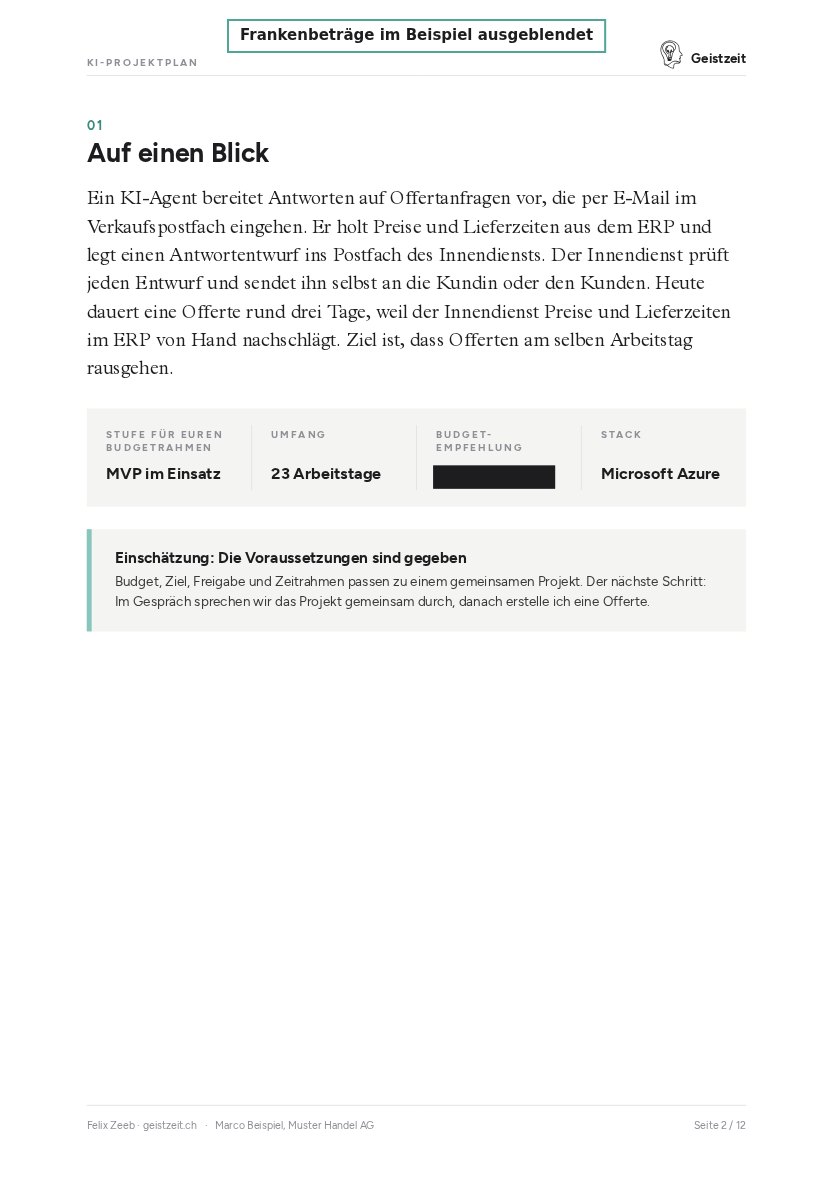 At a glance
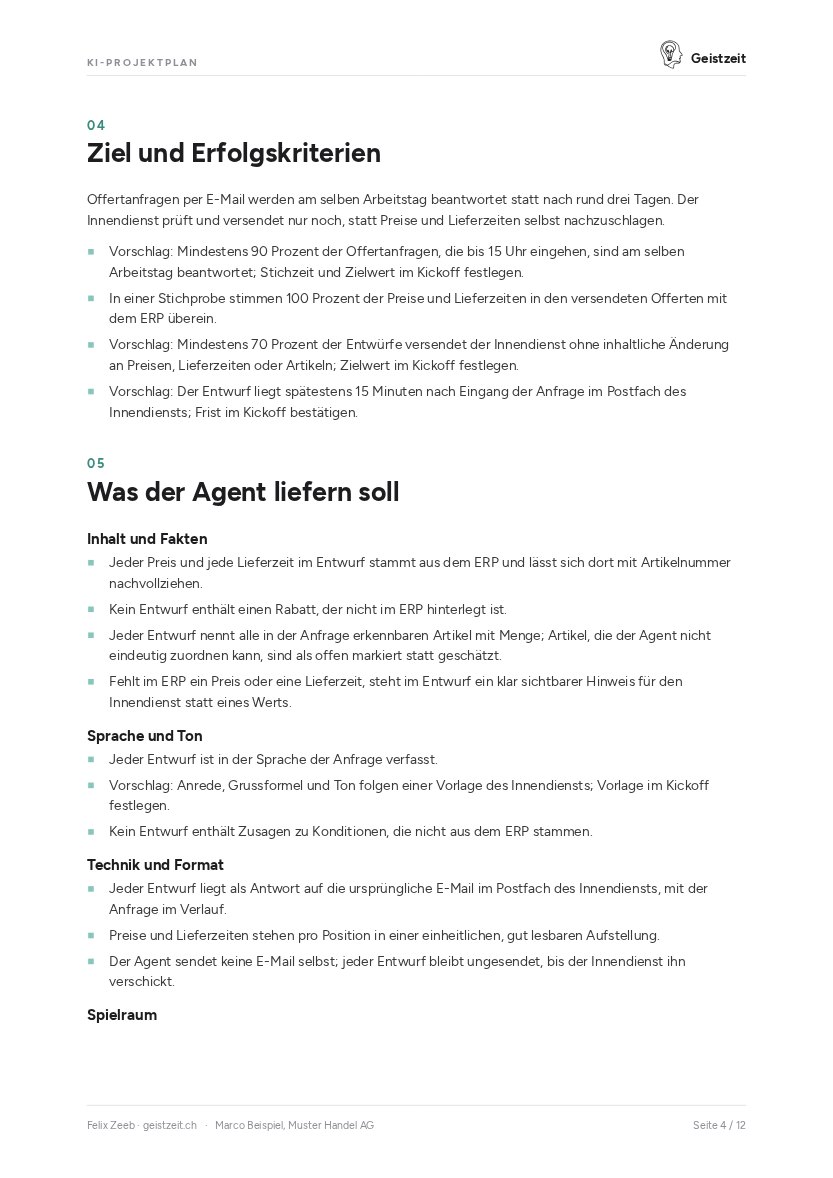 Goal and output
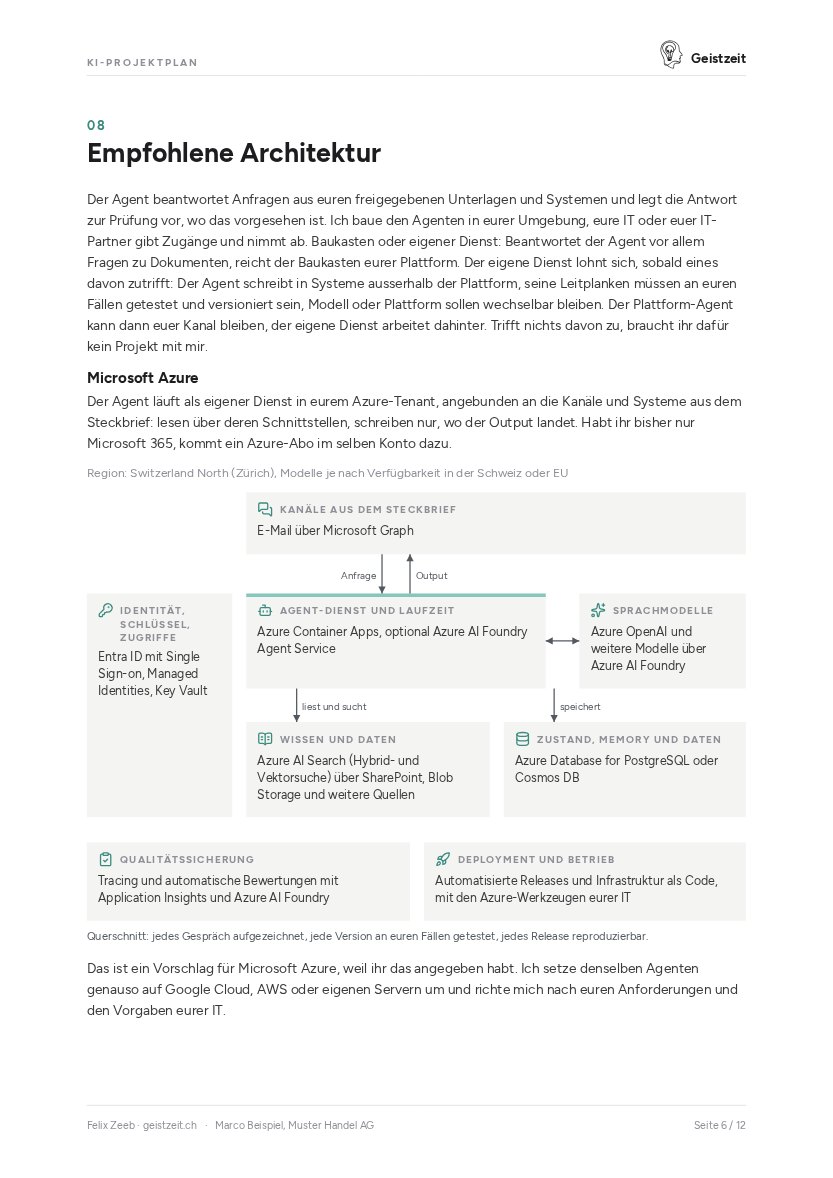 Architecture for your cloud
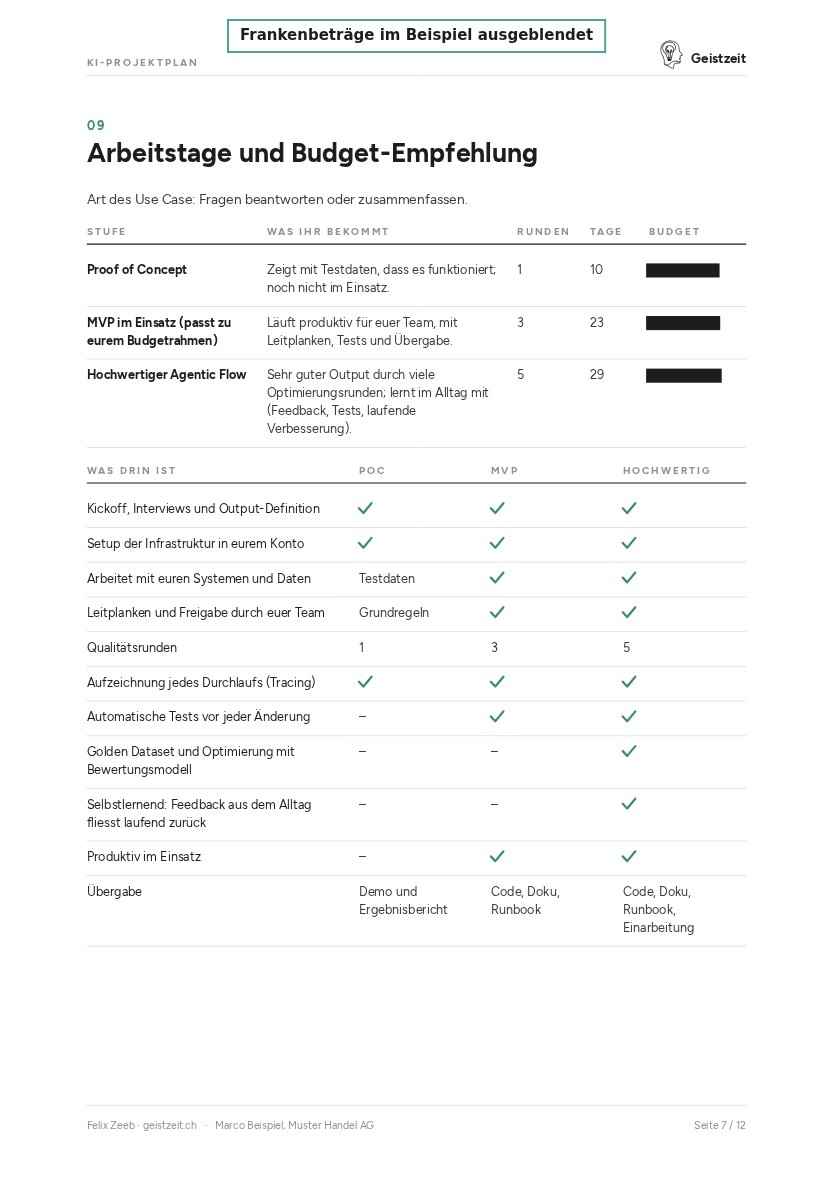 Three stages, working days and budget recommendation
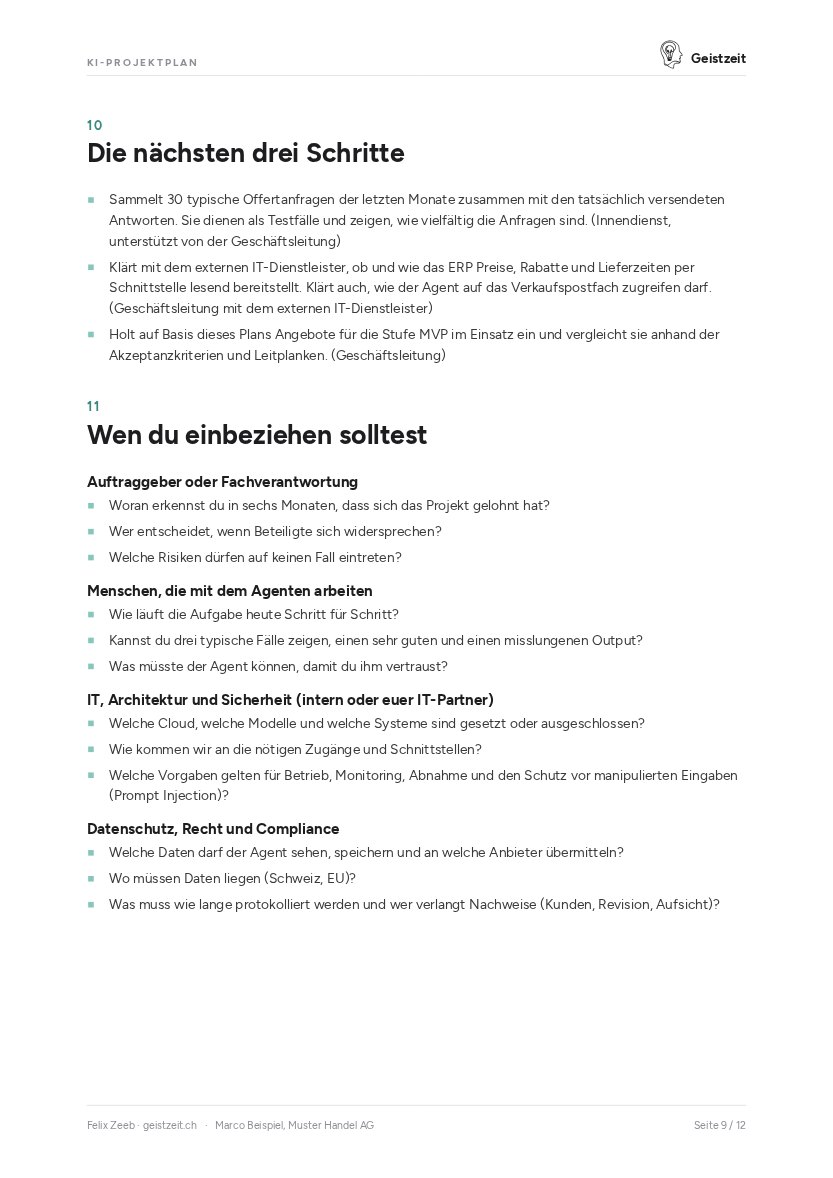 Next steps and people involved
Checked before sending: the checker agent's verdict (1 to 5)
First draft sent back by a fixed style rule, the second passed: average 4.4 of 5.
- Faithfulness4
- Completeness4
- Specificity5
- Testability4
- Actionability4
- Consistency4
- Clarity5
- Safety5
Critique on completeness (translated): «What has not been processed is the volume ‹around 40 quote requests per week›.»
Why quality checks and evaluation loops matter: in development, every draft is checked against fixed criteria and revised until it meets them, so the agent is built on real cases rather than gut feeling. In operation, every change, whether a new version, a model switch or new data, first runs against the same test cases, and whatever stands out in daily use becomes the next test case. So the agent gets measurably better the more your team uses it and thereby trains it.
How the planner is built
- Youtell your idea
- Interview agentasks until everything needed is there
- Live cardshows how it understands you
- Writer agentwrites the plan
- Checker agentscores it on eight criteria, up to five revisions until the quality is reached
- Your planas a link and a PDF
I build the same mechanism in projects every day for companies that want to use AI applications.
The learning loop
Every conversation goes into tracing, masked; whatever stands out becomes a test case.